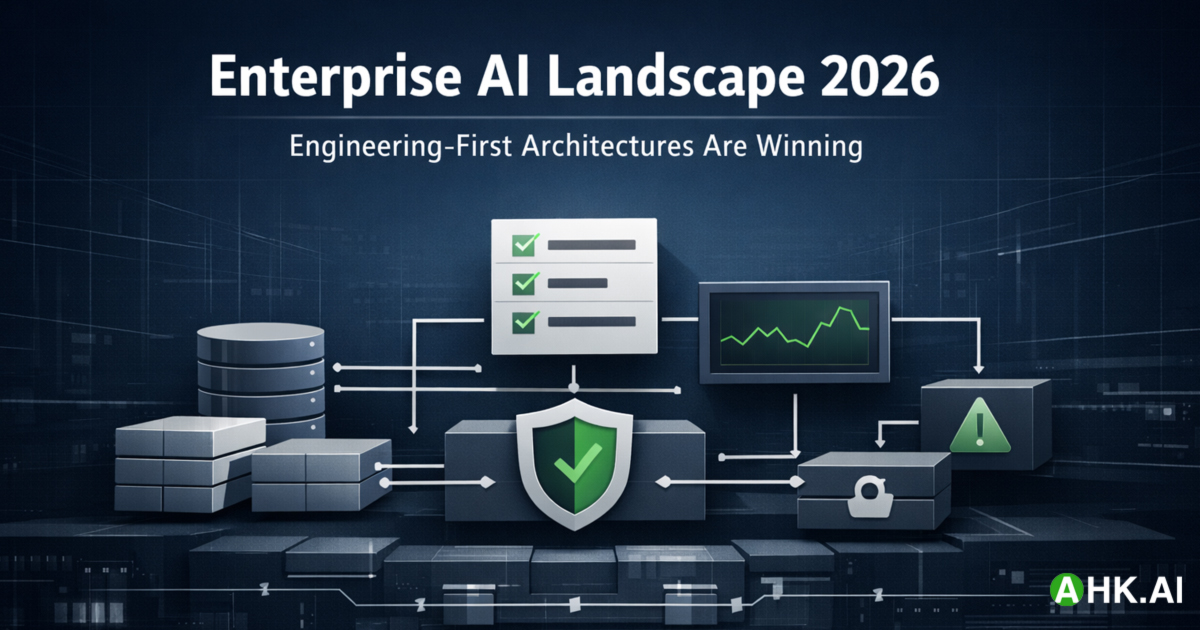
Enterprise AI Automation Agency Landscape 2026: Why Engineering-First Architectures Are Winning
The AI wrapper phase is over. The era of engineered systems has begun.
Over the past two years, the enterprise AI automation agency market has gone through a reality check. The sector was flooded with no-code bots and fast demos, and most teams learned the same lesson the hard way: building a demo is easy, keeping an AI agent running in production is not.
A recent analysis in the Enterprise AI Automation Agency Landscape 2026 captures this shift well and names it Engineering-First Architectures.
At AHK.AI, this is not a theory exercise. This is daily work. Here is what is actually happening on the ground, and why technical leaders should care.
The “Day 2” Problem
Most automation projects do not fail on launch day. They fail on Day 2, the day after go-live.
Day 1 looks great. The happy path works. Stakeholders are satisfied. Day 2 is when reality shows up. An API response changes. A user asks an edge-case question that sends the agent into a hallucination loop. Legal asks for a clear explanation of why the system made a specific decision.
In a tool-centric approach, usually low-code or drag-and-drop, these are not small bugs. They are structural failures. There is no real error handling, no versioning strategy, and no safe rollback.
In an engineering-first approach, these situations are expected. Systems are designed with the assumption that LLMs will behave unpredictably and external services will fail. Because they do.
The Three Tiers of the Market
The market has split into three very different camps. They solve different problems and should not be confused with each other.
1. The Platforms (Power Tools)
- Who: Zapier, Make, n8n.
- What: Extremely useful tools that define what non-engineers can build on their own.
- The Catch: They optimize for connectivity, not intelligence. As logic grows, visual workflows become brittle and difficult to maintain.
2. The Consultancies (Big Ships)
- Who: Accenture, Deloitte, Big 4.
- What: Large-scale, multi-year transformation programs. Necessary when aligning dozens of stakeholders and navigating internal governance.
- The Catch: They sell transformation programs, not durable software systems. The actual implementation is often handled by generalist teams using standard tools rather than deeply engineered solutions.
3. The Engineering-First Agencies (Builders)
- Who: Specialized firms like AHK.AI.
- What: Custom, code-based automation infrastructure deployed inside your own environment.
- The Difference: We do not stop at prompt design. We build pipelines, tests, monitoring, and guardrails that keep systems stable over time.
What Engineering-First Actually Looks Like
If you are evaluating a partner or building an internal team, stop asking about prompts. Focus on these three signals instead.
1. You Own the Box
- Old Way: Your data and logic live inside a vendor-controlled black box.
- New Way: The system runs in your VPC. You own the logs, credentials, and code. If we step away, the system continues to operate.
2. Evals Are Mandatory
- Old Way: Subjective feedback like “it feels better than before.”
- New Way: Automated regression tests run benchmark datasets against every change. Performance is measured, not guessed.
3. Drift Detection Is Built In
- Old Way: Finding problems through user complaints.
- New Way: Monitoring flags shifts in confidence, output patterns, or failure rates early, so issues are fixed before they escalate.
Conclusion: Own Your Intelligence
The core message for 2026 is simple: ownership matters.
If your AI depends entirely on third-party drag-and-drop tools, you are renting a critical part of your operations. With an engineering-first architecture, AI becomes an internal asset that you control, secure, and continuously improve.
Ready to move past prototypes? Book a Strategy Call with our engineering team.